Anyone involved in a Point-in-Time count knows how quickly the work can become complicated.
Volunteers need to be recruited. Surveys need to be prepared. Shelter data needs to be collected from agencies that may not use HMIS. Unsheltered outreach teams need to know where to go. And once the count is complete, all of that information still needs to be reviewed, consolidated, and prepared for HUD submission.
That is a lot to manage for a single moment in time.
But the PIT count does not have to be an annual scramble.
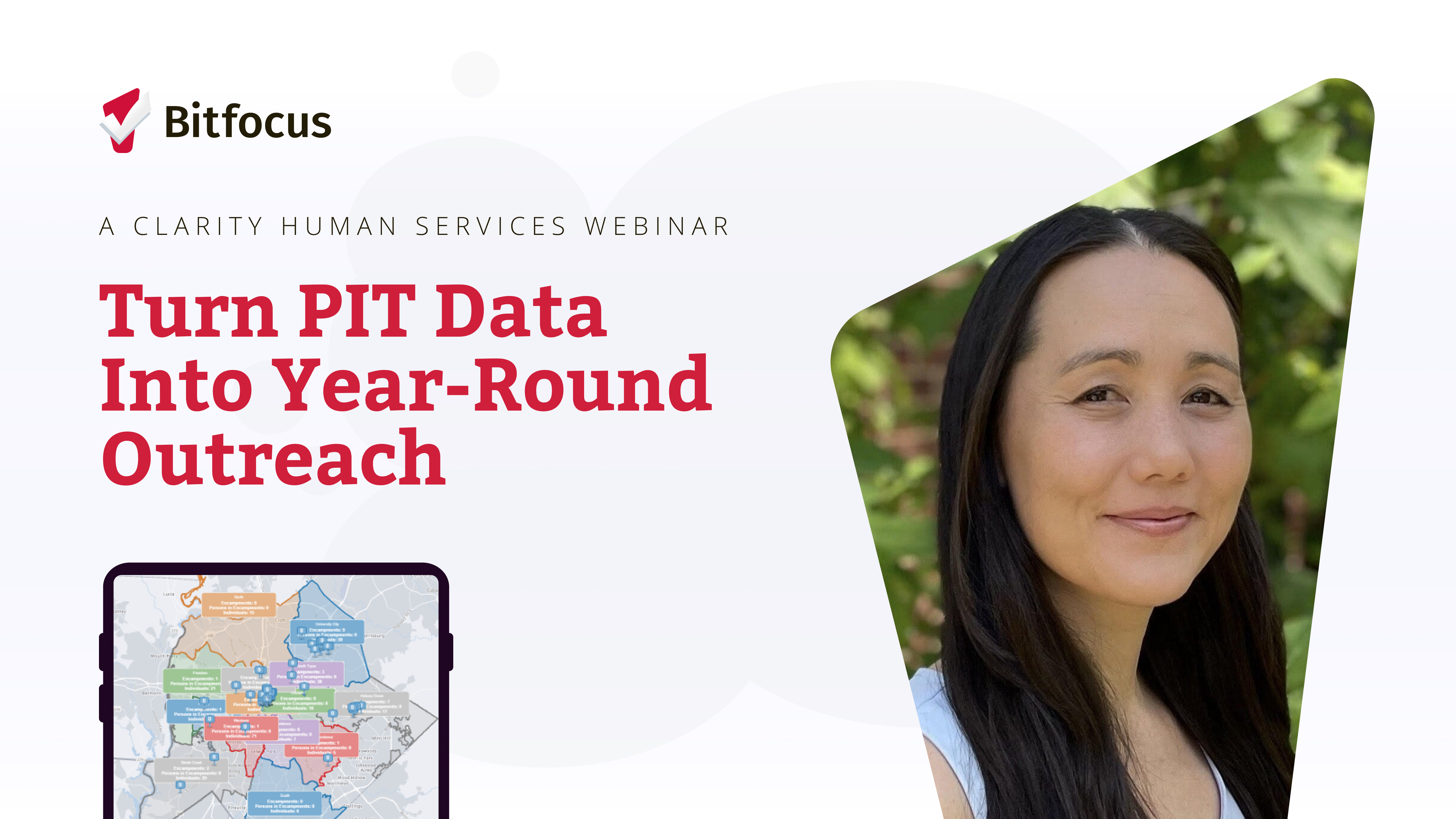
In a recent Bitfocus webinar, Tina Emond, Project Manager at Bitfocus, walked through a more connected approach to PIT planning, data collection, reporting, and year-round outreach. The conversation focused on how Clarity Human Services and Survey123 can work together to support the full PIT count journey — from volunteer management and mobile surveys to data import, HUD reporting, outreach mapping, and ongoing encampment coordination.
The biggest takeaway was simple: the value of PIT data should not end when the report is submitted.
When communities use PIT data as a baseline for year-round outreach, the count becomes more than a compliance requirement. It becomes a foundation for better planning, stronger coordination, and more informed action.
PIT planning starts before count night
Most communities do not begin the PIT count with a blank slate.
They begin with last year’s workflows, existing provider relationships, volunteer lists, shared drives, spreadsheets, outreach knowledge, and lessons learned from previous counts. Those tools often reflect a tremendous amount of effort from HMIS teams, outreach staff, system leaders, and community partners.
But they can also create friction.
Information may live in too many places. Volunteer assignments may depend on manual coordination. Shelter contacts may be stored in a spreadsheet that has not been updated recently. Survey tools may not work well in the field. And when data comes back from multiple sources, teams may spend significant time cleaning, matching, validating, and preparing it for submission.
The issue is not effort, it’s infrastructure.
That was one of the central points of the webinar. Communities are already doing the work. The opportunity they have is to connect that work through tools and workflows that make the PIT process easier to manage from beginning to end.
In the session, Bitfocus described an integrated approach where Survey123 supports frontline data collection and volunteer management, while Clarity serves as the central hub for data consolidation and HUD-compliant reporting. Together, those tools can help communities move from disconnected annual processes toward a more coordinated PIT workflow.
That matters because PIT success is not only about what happens on count night. It is about whether the system is prepared before the count begins, whether teams can collect reliable information in the field, and whether that information can be used after the count is over.
Volunteer management works better when it is structured
A strong PIT count relies on a prepared volunteer workforce.
During the webinar, Bitfocus described volunteer management in four phases: collect, control, assign, and track. These steps help communities think about volunteer coordination as more than sign-ups. Volunteer management is a complete workflow that starts with recruitment and continues through training, access, deployment, and safety.
With Survey123, communities can use a customizable volunteer application to collect the information they need. That may include a volunteer’s name, preferred shift, geographic availability, device access, and other details that support planning.
From there, communities can control when volunteers receive access to surveys. That is important because not every volunteer should have access immediately. Some may need to complete training first. Others may need to sign a waiver or receive an assignment before they begin collecting data.
Once volunteers are ready, teams can be assigned to the areas where coverage is needed. Instead of relying only on static lists or separate spreadsheets, communities can match volunteer capacity to geographic needs. They can also track who has checked in, who has gone into the field, and who has returned.
That kind of visibility supports more than logistics. It supports safety, accountability, and confidence.
When communities know where volunteers are assigned and what work is happening in real time, they are better equipped to manage the count as it unfolds.
Field data collection should be built for the field
The webinar also emphasized the importance of mobile-first survey collection.
PIT surveys are often completed in real-world conditions that are not always predictable. Volunteers may be working from phones or tablets. They may be in areas with limited cell service. They may be new to the process and unsure which questions to ask next.
That is where survey design matters.
Survey123 offers a prebuilt PIT survey that includes HUD-required questions, while still allowing communities to customize the survey with local questions when needed. It is designed for mobile use, supports complex skip logic, works offline, and captures GPS coordinates for unsheltered locations.
Those details can make a meaningful difference during the count.
Skip logic helps volunteers move through the survey without needing to interpret every possible path on their own. Offline functionality helps teams continue collecting information even when connectivity is limited. GPS capture helps communities understand where unsheltered surveys were completed and how those locations may inform outreach planning later.
This is where data collection becomes operational.
The goal is not only to collect the required information. It is to collect it in a way that is usable, consistent, and connected to what the community needs next.
Data consolidation is where many PIT counts slow down
One of the clearest pain points discussed in the webinar was data consolidation.
When attendees were asked about the hardest part of the PIT count, putting the data together stood out as a major challenge.
That will sound familiar to many communities. PIT data often comes from multiple places. Sheltered data may come from HMIS programs. Some shelter data may come from agencies that do not use HMIS. Unsheltered data may come from field surveys. Custom questions may need to be reviewed. Duplicates may need to be considered. Missing or unexpected responses may need to be addressed.
The webinar showed how Survey123 data can be transformed into a file and uploaded into Clarity. From there, teams can map fields, review skipped columns, validate the import, check summary counts, and view the imported data by household or individual.
This does not eliminate every data challenge, but it creates a clearer process.
Instead of piecing together information after the fact, communities can bring their unsheltered PIT data into the same central system where their sheltered data already lives. With both in one place, Clarity can support reporting through the HUDX 230AD Shelter Count PIT report, which combines sheltered and unsheltered counts in a format that closely mirrors HDX submission tables.
That alignment matters.
When reporting outputs look familiar and are organized around the information HUD needs, teams can spend less time translating data into the right format and more time reviewing whether the data is accurate.
PIT data can become the starting point for outreach
The most important shift discussed in the webinar happens after the PIT count.
Once unsheltered PIT data is imported into Clarity, communities can make that data available as a map layer in the Outreach module. That allows teams to see where surveys were completed and identify clusters of unsheltered homelessness.
For communities already using outreach mapping, PIT data can be layered into existing information. For communities that are just getting started, the PIT count can provide a baseline.
That baseline is powerful.
It can help teams identify possible encampments, understand geographic patterns, and plan outreach coverage more effectively. It can also help communities move from a static count to a living outreach map that continues to evolve throughout the year.
In the webinar, Bitfocus demonstrated how teams can create encampments in Clarity Human Services’ Outreach module, draw boundaries, add people to encampments, move clients between locations, update encampment details, and maintain notes and alerts.
Those tools help turn PIT data into coordinated action.
A note might document that an outreach team delivered water to a location. An alert might warn other teams about an urgent safety concern. An updated encampment boundary might reflect changes observed during recent outreach. A moved client record might help teams keep location information current as people move through the community.
This is where the PIT count becomes part of the year-round work, not separate from it.
Year-round outreach makes the next PIT count stronger
The webinar closed with an important reminder: communities have to keep going.
The PIT count may happen once a year, but outreach does not. Encampments change. People move. Needs shift. New locations emerge. Existing locations close or shrink. Outreach teams learn more every time they go into the field.
When that information is maintained throughout the year, the next PIT count becomes easier to plan.
Communities can better understand where people are likely to be. They can allocate volunteers more strategically. They can identify what supplies may be needed. They can see what information is missing and use that knowledge to improve future survey questions.
That creates a stronger annual cycle.
The PIT count informs outreach. Outreach updates the map. The map supports planning. Planning improves the next PIT count.
Over time, the process becomes less reactive and more informed.
That does not mean every challenge disappears. Deduplication, extrapolation, custom data collection, non-HMIS shelter data, and system-specific workflows still require thoughtful planning. The Q&A portion of the webinar made clear that there are details communities need to work through based on their local approach.
But the direction is clear.
When PIT data is connected to established, ongoing outreach infrastructure, it becomes more useful. And when communities can use that data throughout the year, they are better prepared for the next count before planning even begins.
What this means for communities moving forward
At its core, this webinar was about making the PIT count easier to manage, easier to report, and more valuable after the reporting deadline passes.
That starts with better coordination before the count. It continues with mobile tools that support field-based data collection. It depends on a clearer process for bringing sheltered and unsheltered data together. And it becomes more powerful when PIT data is used to support outreach mapping, encampment coordination, and year-round planning.
Communities do not need to solve every PIT challenge all at once to start improving the process.
They can begin by strengthening volunteer workflows. Or by creating a better source of truth for shelter contacts. Or by moving from paper surveys to mobile collection. Or by using imported PIT data to inform outreach maps. Each improvement creates more visibility, more consistency, and more capacity for action.
Because the PIT count should not be an annual scramble.
It should be part of a larger system of learning, planning, and outreach.
And when communities use PIT data beyond the count itself, they are better positioned to understand where people are, coordinate across teams, and build a stronger response year after year.
Explore how Clarity Human Services and Survey123 can help your community streamline PIT planning, simplify reporting, and turn PIT data into year-round outreach action.