Clarity Cast by Bitfocus brings together people who use data and field experience to strengthen homeless response.
In this episode, From Counts to Coordinates, host Angela Evans spoke with Dr. Este Geraghty, Chief Medical Officer at Esri, about how communities move beyond a single-night count and use location data to guide outreach, planning, and daily decision-making.
Here is what teams can take from the discussion.
PIT counts still matter
Dr. Geraghty opened with a clear point: communities need a baseline before they can plan anything meaningful. “You can’t manage what you can’t measure. Until you have that situational awareness, you’re blind to what to do next.”
PIT data provides that foundation. It shows the scale of unsheltered homelessness, highlights broad geographic patterns, and gives teams a common frame for decisions that follow.
Angela noted that the count also shapes how people understand the daily work itself. Staff and volunteers who join ride-alongs see street conditions directly, which often shifts how they think about outreach and resource planning through the rest of the year.
The limits of traditional counts
Most PIT challenges trace back to the older processes many communities still rely on. Paper forms, scattered notes, and manual entry slow the work and introduce avoidable errors. Bad weather ruins surveys, unclear handwriting forces cleanup, and weeks often pass before anyone can use the results.
These gaps limit what communities learn. Without precise locations or clean, timely data, teams cannot see how unsheltered patterns shift across seasons or respond to changes with much confidence. The count becomes a required snapshot rather than a tool that supports strategy.
Location data changes outcomes
Two real-world situations showed how precise location data shapes decisions when it matters.
San Bernardino County faced a dam release during a severe storm with only a few hours of notice. Staff already knew where unsheltered residents were sleeping inside the flood zone because those locations were documented during the county’s digital PIT count. With that information ready, volunteers received clear directions through an operations center and reached people before conditions became unsafe.
Abbotsford, British Columbia, dealt with a different problem: uncoordinated outreach. Nineteen organizations operated across wooded encampments without shared maps. Some areas saw repeated visits; others saw none. Once the community created a common view of encampments and outreach activity, coverage balanced out and duplication dropped.
Both examples point to the same conclusion. When communities work from accurate coordinates, they respond faster and plan with more certainty because their decisions reflect real conditions rather than assumptions.
Digital tools make PIT work faster and lighter
After outlining where traditional counts fall short, the conversation turned to what digital tools make possible. Dr. Geraghty walked through Esri’s digital PIT workflow, which cuts down the effort required to manage volunteers, collect data, and meet HUD reporting requirements. Angela linked that overview to what many communities feel each January: too much time spent repairing data and too little time spent understanding what it shows.
The digital workflow takes over the pieces that slow teams down:
- Volunteers sign up through a central hub and select canvassing areas
- Mobile surveys replace paper forms in the field
- Dashboards display coverage and early patterns as responses come in
- HUD forms populate automatically once submissions are complete
As communities look for ways to bring this work closer to their HMIS processes, our new integration will now let Survey123 responses flow directly into Clarity. The goal is simple: reduce the steps teams take after count night and give them reliable PIT data faster.
Why continuous visibility matters
The conversation moved past PIT night to what becomes possible when geolocation stays active throughout the year. When location ties to HMIS encounters and outreach work, teams see how encampments shift, where unsheltered activity increases, and when new patterns emerge.
Angela noted that many Clarity communities already use these capabilities. Location fields connect to assessments, services, and outreach encounters, giving staff a clearer picture of where to focus their time. Route planning becomes more precise, and decisions reflect current conditions rather than memory. The PIT count offers the first layer of insight; ongoing HMIS work builds the rest.
This reflects the approach behind our Beyond the Count campaign: use PIT as the starting point, then let real-time data in Clarity show how unsheltered patterns change throughout the year.
Privacy depends on governance as much as technology
Privacy questions surfaced quickly. Outreach teams worry about how encampment locations might be used and who might see them, and that concern is warranted.
Dr. Geraghty first addressed the technical side. ArcGIS encrypts data in transit and at rest, and communities control access to each layer and attribute. The system does not require anyone to share sensitive locations with partners who have not earned that level of trust.
She noted, though, that technology is only part of the solution. Communities still need clear internal rules that define why location data is collected, how long it is kept, who may view it, and how staff handle it. Angela reinforced the point and reminded attendees that informal tools, especially shared documents, expose clients to unnecessary risk.
Protecting client information depends on strong technology backed by disciplined governance.
Integrating PIT, HMIS, and location data
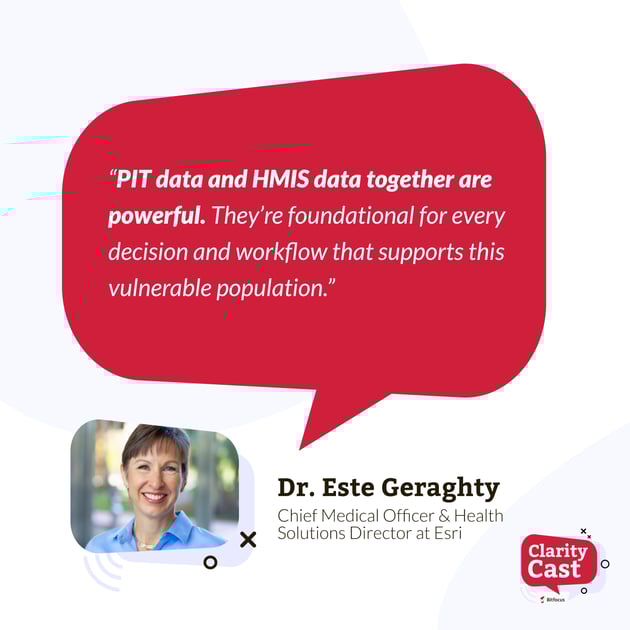
Bitfocus and Esri continue to partner so communities can connect PIT data, HMIS records, and location insight without relying on disconnected workflows. Dr. Geraghty captured the value clearly:
“The point-in-time count information and the HMIS information are together so powerful. They’re foundational for every type of decision and workflow that you have to support this vulnerable population.”
Angela noted that most communities operate with fewer resources than the work requires. Using location inside HMIS helps teams direct those resources more precisely. It does not replace the need for investment, but it improves the impact of daily decisions.
Communities preparing for the next count or exploring ways to connect PIT, HMIS, and location data can reach out to learn how the Survey123–Clarity integration supports those workflows in practice.